The thinking behind the lines

Little Hands, Big Benefits

Why my coloring pages have big spaces, bold outlines and not a single teeny tiny petal.

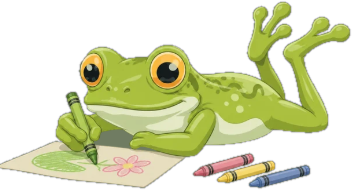
Frog lying on his belly coloring a flower with crayons

When I sit down to draw a coloring page for little ones, I'm thinking about the kiddo holding the crayon. Small hands are still figuring things out. They're learning how to hold a crayon, how hard to press and how to get the color to land where they want it.

So I keep things simple on purpose. Big shapes. Thick, bold outlines. Plenty of room to color. I also wanted to know what the research actually says, so I could be honest with you about what coloring can and can't do. Here's what I found.

What the studies found

Coloring and coordination go hand in hand

A team of researchers in Taiwan has spent the last few years looking closely at how preschoolers color and what it can tell us about their development. Here's the short version, in plain English.

2024 study

Coloring skills grow with age

Researchers created a way to score children's colored pictures, looking at things like coloring outside the lines and leaving unexpected blank spots. In 239 children ages 3 to 6, coloring scores went up with age and were connected to visual-motor integration, which is a fancy way of saying how well the eyes and hands work together.

American Journal of Occupational Therapy

2023 study

Coloring is one piece of the puzzle

This study looked at coloring, origami folding and copying shapes in 370 kindergarteners. Each activity was connected to visual-motor skills. Folding and copying together showed the strongest connection, so coloring on its own is a helpful clue, not the whole picture.

American Journal of Occupational Therapy

2025 study

A coloring page can be a window

Researchers taught a computer program to look at the coloring of 505 preschool children. In the test group, it correctly sorted kids by their visual-motor development about 80% of the time. The authors see coloring as a possible screening tool someday.

Annals of Medicine

What these studies did and didn't show

All three studies looked at coloring as a reflection of skills kids are already building. None of them tested whether coloring improves those skills, and none of them compared different coloring books, including mine. So I'm not going to tell you that coloring makes kids smarter or that my books are better than anyone else's. What the research does tell me is that coloring and those growing eye and hand skills are closely connected.

The good stuff

What coloring has to do with growing up

Research connected in the studies abovePotential makes sense, not provenDesign choice why I draw it this way
Research

Hand-eye coordination

This is the big one. In all three studies, the way children colored was connected to how well their eyes and hands work together.

Research

Fine motor skills

Guiding a crayon where your eyes want it to go takes small, controlled hand movements. That eye and hand teamwork is exactly what these researchers measured, and coloring is one everyday way little fingers practice it.

Potential

Getting ready to write

Steering a crayon around a shape uses the same kind of eye and hand teamwork kids will need when they start forming letters. These studies didn't look at handwriting, so I'm not claiming coloring teaches it. It just makes sense as good practice.

Potential

Creativity

Purple cows, rainbow pumpkins, a bright green Mousey. Simple pages leave plenty of room for kids to make their own choices. No study here measured creativity, but I love seeing what little imaginations come up with.

Design choice

Confidence

A page a child can actually finish feels like a win. Big spaces make it easier to fill in a whole picture and proudly hand it over for the fridge. That's my hope for every page, not something research has proven.
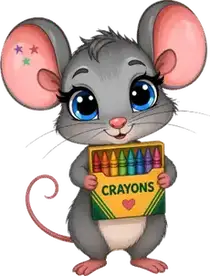
Mousey holding a box of crayons
Design choices

Why big spaces and bold outlines?

Little hands that are still developing coordination have a lot to manage at once. Here's how I try to make coloring feel more approachable.

  • Easy to see

    Thick, dark outlines show exactly where one shape ends and the next one begins.

  • Forgiving

    If the crayon wanders a little, a big space and a bold line still make the picture look great.

  • Doable

    Fewer tiny areas means less frustration and a lot more finished pages.

  • One picture per page

    Nothing busy competing for attention. Just one picture to focus on and enjoy.

Just so we're clear

These are my design choices, based on what makes sense for little hands that are still learning. The studies above didn't test page designs, so think of this as thoughtful common sense rather than proven science.

A few tips

Grab your crayons

Colored pencils and fine tip markers work best. I don't recommend big markers because they can bleed through the page.

Every child grows at their own pace. Some kids color inside the lines at three and some couldn't care less at five, and that's okay. The point is to have fun.

For the curious

The Research Behind the Fun

  1. Huang, C.-Y., Lin, G.-H., Lu, S.-C., & Lee, S.-C. (2024). Quantifying coloring skills among preschoolers. American Journal of Occupational Therapy, 78(3), 7803205080. https://doi.org/10.5014/ajot.2024.050519
  2. Huang, C.-Y., Yu, Y.-T., Chen, K.-L., Lin, G.-H., & Hsieh, C.-L. (2023). Using artificial intelligence to identify the associations of children's performance of coloring, origami, and copying activities with visual-motor integration. American Journal of Occupational Therapy, 77(5). https://doi.org/10.5014/ajot.2023.050210
  3. Huang, T.-Y., Chen, K.-L., Lin, G.-H., & Huang, C.-Y. (2025). Using a coloring activity to identify children's development of visual-motor integration: An application of artificial intelligence. Annals of Medicine, 57(1), 2578725. https://doi.org/10.1080/07853890.2025.2578725

Made for little hands and big imaginations

Every Just Mousey coloring book is drawn with the kiddo holding the crayon in mind.

Good TunesWhat J.M. is listening to